Monday, February 04, 2013

Beatles 2012 Vinyl Box Set - Rainbo Pressing Issues

I've mentioned previously on the blog about the new Beatles Stereo Digitally Remastered Vinyl LPs that hit the stores in November.

Many "purist" have been complaining that the fact it's a DIGITAL remaster totally defeats the purpose of a vinyl reissue. 

Consider, however, that the original analog master tapes are almost 50 years old or more now.  Digitization is the best way to preserve these gems forever.  I think the sound engineers are working with the best technology possible, and are able to archive in 24bit/192khz digitization, which is pretty close to damn near perfect.

keep in mind that vinyl doesn't have the same compression limitization that CD has, and you get a pretty nice representation of the Beatles' music.

I bought a copy of the White Album just before Christmas, and wrapped it up and stuck it under the tree.  Opened it up on Christmas day and looked at Record One, Side One.  Pretty good.  Threw it on my turntable and nice.

About a week later, I took a look at record one, side two.  Holy crap!  No WAY I did this!!!!!  Looked like somebody dropped something right on top of the record.  Have a look at the photos:


Ouch!!!!  In all the years I've been purchasing and/or collecting records, never have I seen ANYTHING like this!!

Go on Amazon.com and see the number of customer complaints re: this reissue.

I sincerly hope that EMI/Capitol gets their act together for the MONO Vinyl releases in May 2013

- MEESTER MUSIC

Friday, January 25, 2013

THE ART OF TRANSFERRING TO DIGITAL (part two)


Ok, so let's make the assumption that you have acquired a half-way decent turntable!  You don't have to spend a ton of money at this point.  Just so long as the table will deliver a relatively good signal, with minimal motor noise, rumble, wow & flutter.
As I've mentioned, an old skool table will do the trick.  Just be careful of a worn stylus, loose belts, uneven speeds.  What I did was take my old Dual 506 in to RING AUDIO and let the boys at 'er.  I asked for a new belt, check out the motor, stylus and cartridge.  Got the table back with a new belt (important, as the belt has probably stretched out of shape if standing around for too long) and was told my stylus was still good, probably an average year's worth left.  Then bring it in for a replacement.  GOOD TO GO!

The next step is getting the signal from your turntable cartridge to your PC.  If you just run your turntable and leave your amp/receiver OFF, you can hear the signals coming off the cartridge but with no amplification.  Excellent!  That is what your amp/receiver does.  Provided you have a phono input, that signal from the cartridge will be amplified AND RIAA equalization put on the signal before it is forwarded to your speaker system.

Whoa....wait...RIAA equalization?  What the heck is THAT?  Well, try to imagine how those sound engineers put 20 minutes worth of music on one side of a 12" hunk of plastic!  To be able to fit all those grooves onto the platter, the low end frequencies were supressed (limited) and the high ends exaggerated a bit.  I'm no expert on this.  Click here, RIAA EQUALIZATION , to better understand what I'm talking about.

One good thing....most of the old receivers/amps have this RIAA EQ built into their electronics via the phono input jack.  But a lot of the newer receivers/amps DO NOT HAVE A PHONO INPUT!!  Running your turntable into anything but a phono input jack will not work, and might even damage your amp/rcvr.

That is where a phono pre-amp comes in.  It will take the place of the old circuitry that was present in the receivers with a phono input.  Also, a phono pre-amp allows you to plug your turntable directly into the pre-amp without having to set up a big, space-consuming rcvr.

There are many different phono pre-amps available.  Costs start at around $200.   I purchased a Rega Mini FONO A2D pre-amp.  (A2D = "Analog to Digital").  See the photo (Front View - Left, BackView - Right):


Simple to use.  On the front, there is a level controller, then the USB outlet, followed by a Earth pin (for ground).   The back view shows white/red INPUT RCA jacks, another set of OUTPUT RCA jacks, an input jack for the charger, and a red LED light to indicate when it on.

Not too hard to set up.  Red and White RCA jacks from your turntable into the pre-amp INPUT jacks.  Then a special cable that runs USB from the output jack to a usb terminal on your PC (I bought gold-plated ones from STAPLES for $30 CDN).

I can put my turntable, the phono pre-amp and my laptop on a regular-sized coffee table.

If you have an old rcvr/amp, you can run your turntable into the phono input jacks, then you can buy a cable that will allow you to run out of the HEADPHONE socket and into the microphone socket on your PC/laptop.  It works, but I found that there was a lot of noise and other issues that made it unreliable.

And that's really what you want.....a solid, reliable signal.  Otherwise, why bother?

You will need software on your PC to be able to further manipulate the music.  The best one out there is a cool program called AUDACITY.  


It's free.  Download it and the manual and any tutorials.  A bit of a learning curve, but not so steep that with a little determination, you couldn't figure it out.  (After all, you got THIS far, didn't you?).

That's it in a nutshell!  If you don't believe how good it sounds, check out my podcast "Rippin' Da Vinyl" elsewhere on my blog.  All the tunes I used for that show were ripped off the vinyl and onto my laptop in this exact fashion.  Even transferring back to mp3 192kbps for broadcasting purposes, the sound still came through.

Good luck. Drop me a line in the comments section if you have any questions or issues.

- Meester Music

Sunday, January 20, 2013

THE ART OF TRANSFERRING TO DIGITAL (part one)

Not too long ago, I was in a downtown record store on Yonge Street.  A young couple were standing next to me and eyeballing the latest in USB Turntables, and they were discussing how they wanted to transfer a lot of their stuff to digital format so that they could put their stuff on their iPod/iPhone.

This turntable retailed for around $80 CDN.  Not bad price, I thought.  Then I took a closer look.  Oh boy.

The whole body of this turntable appeared to made of some kind of plastic.  ANY kind of noise near this unit is going to be transferred right into that tonearm and onto whatever/where ever you are recording.  Besides, plastic is a lot cheaper than the old wood they used. 

But wood must have been good for something other than just nice to look at.  The REASON was that wood does not conduct sound very well.  Turntables TURN because of a motor mounted inside.  Motors are not 100% smooth, so wood dampens the vibration, resulting in a lower wow and flutter value.  Important!!!

Plastic?  Ouch.  Don't have the numbers in front of me, but I'm willing to bet that plastic-body TT's carry all kinds of wow/flutter and turntable RUMBLE.  Not good for those quiet passages, eh?

The tonearm:  not even a counterweight to set the tracking force of the stylus/cartridge.  So we are looking now at something I might have owned when I was a kid.  I've even read stories on the net about these tonearms and their INABILITY to ride out the grooves on some modern releases.

What kind of cartridge/stylus combo are we looking at?  Hmmm...dunno.  Is the tonearm plastic too?  The trend these days is towards carbon fibre material.  No resonance, no extra noise, just the sound off the record.

Needle won't track?  Solution simple, right off the internet (I swear it's true):

TAPE A PENNY TO THE TONEARM HEAD. 

This will not be a viable solution in the coming years, as the Canadian Government is not making pennies anymore.  Better start hoarding them NOW.

What is this, 1965?  Mom and Dad's Turntable?  Next thing, you are going to tell me that you want to stack your LPs three or four at a time, and let them drop down to the record below on your platter when you are done. 

Fun to look at when you are a kid.  Do you think it's so much fun to watch a $30 Audiophile Remastered record drop down about 8 inches or so onto ANOTHER $30 Audiophile Remastered record?     Yeah.....didn't think so.

Time out!!

You want to pay $80, OK.  Then please....don't complain when your vinyl sounds like shit when you hear the end result in digital format.  Oh yeah:  "Vinyl sucks, man!"   No.......your TURNTABLE sucks.

So my first word of advice is this:  spend the money on a half-way decent USB turntable.  Audio-Technica makes a nice brand in the $400 range.  Nice and solid.


Or.....find a used "old skool" turntable.  They are available.  And you can get a working one from a place like Ring Audio for around $100 or so.

NEXT UP:  PART TWO - ok, ya got the turntable.  Now what?

Thursday, December 27, 2012

Turntable Upgrade

Well, after almost 30 years with the same Dual 506, I finally went for an upgrade with the Christmas money I received this year.

I purchased a brand spanking-new PRO-JECT DEBUT CARBON turntable.  I got it from a really cool audio shop in Toronto called AUDIO OASIS.  Check out the link to their webpage.  If you ever get a chance to drop in, say hi to George!

Here is a picture of the turntable.  Black.  "Piano" they call it.

Awesome.

Carbon tonearm and an audiophile Ortofon 2M RED cartridge/stylus makes for a nice delivery of sound.


Platter is bigger, heavier AND it comes with a felt mat, so it cuts down on static pick-up and hence less pops and clicks.

Got a Boxing Day discount on it!  Took about an hour to assemble.  Cartridge was already mounted, so it was more of putting the belt on the motor (easy), adding the counterweight and balancing off (easy), and then attaching the anti-skating counterweight (easy).

My Dual 506 now becomes my official back-up TT for transferring vinyl to digitial format via my REGA phono pre-amp into my laptop.   The dual 505-2 now goes on sale.  I'm reluctant to part with ANY  turntable, but I've got a real beaut now and a maintained backup.

I also have another Dual 506 but I noticed one of the phono jacks has a break in it and grounds out on occasion.  anyone who is deft with a soldering gun could fix it in about 30 minutes (I do not possess that skill).   I ALSO HAVE an old BSR 25CV MacDonald turntable.  However, the platter is seized and I can't even pry off the platter to fix.  I'm sure a professional could do it in a heartbeat, but I'm not prepared to invest any time/money on this one, so I'll try to sell it too, but for cheap.

Monday, November 26, 2012

Vinyl vs. Digital - THE TRUTH (?)

With the recent release of the Beatles Stereo Catalogue on Remastered, Audiophile 180gm vinyl, the whole issue of analogue vs. digital has surfaced.  Based on more information I've culled from the internet, I may be changing my opinion here.

I think the whole situation boils down to what you PERSONALLY can hear.  As we all know, everyone hears things differently (or at all).  As one gets older, one loses the ability to hear the high end of the audio spectrum.  Typically, a human being should be able to hear tones in the range of 20hZ to 18,000hZ.  Ideally that is.

With advancing age and exposure to daily sounds (jack hammers, traffic noise, etc), that 18,000hZ can quickly erode to 14,000hZ or worse.

The point I'm making here initially, is that those of us who thing perhaps their hearing is special, might be in for a surprise.  Your hearing might not be as discerning as you might think.   

Let's take a look again at how an analogue signal is converted to a digital signal.  Current red book standards for CDs uses 16-bit/44.1khZ sampling rate.  That means that for every second of analogue signal, it is sampled 44,100 times PER SECOND.  This allows the digital signal to capture up to a 22khZ tone.  Remember I said that an average person can probably not hear much above14khZ, so this sampling rate should suffice.

I don't think sampling at 96khZ or even 192khZ (192,000 slices PER SECOND) is REALLY  going to make much difference.    Especially to a "tired" ear.

16-bit allows you to set a level for the each slice of sample.  It assigns a digital number, if you will, for that slice at that particular part of the analogue wave form.  Remember that bits are all part of the binary code, which only allows 1's or 0's.  So a typical value for a slice of the signal includes 16 bits:  xxxxxxxxxxxxxxxx .  It could be something like 0110011110001110.  The next slice might be 0110011110001111.  Now, we have 16 spaces that can be filled by either 1 or 0, and the total number of possibilities is 2 to the 16th power, or roughly 65,000 possible values. 

24-bit then, means 24 spaces or (2 to the 24th power), which then puts the number of possibilities at over 4 MILLION (compared to 65,000).

Better sound?  hang on.  Let's remember that we are still taking about the same dynamic range (the difference between absolute quiet and the noisiest passage in your analogue signal).  Whether you express this dynamic range in 65,000 or 4,000,000 possibilities still doesn't change your DYNAMIC RANGE.  It just refines your digitization process while making your digital file HUGE.

Folks, the average ear just isn't going to hear the difference between a 16bit and a 24bit sample.  SuperEars might, but that is a limited group of people.

Now I find out that most of the newer 180gm vinyl records out there are likely sourced from a digitized form of the master tapes.  DIGITIZED!!  Not analogue!  How many of you are now thinking, "Geez, I've been listening to that audiophile Partridge Family LP and it sounded great!" 

Going back to the Beatles audiophile vinyl reissues, the source is from the Digital Remasters from 2009 (except for "Help!" and "Rubber Soul", which are taken from the George Martin remasters done in 1986).  The digital remaster is 24bit, and had to be "converted" to 16bit for CD production.  CD's must also be processed using limitation, which essentially boosts the sound levels.

The vinyl, on the other hand, doesn't have the 16bit restriction OR the limiting, hence the vinyl is the "purer" signal despite the fact that it's from a digitization of the original analogue tapes.  And if you think you are going to see remasters from analogue tapes in the future, I wouldn't hold my breathe, as most studios have gotten rid of their reel-to-reel tape machines.

So to conclude, trust your ears!!!  If the format you're listening to sounds great, then no worries!!  With the slow degradation of our hearing as we get older, there ain't much we can do about it.  Might as well slap a platter or a CD into your sound system AND JUST ENJOY THE MUSIC!!
                                                                                                  

Saturday, November 03, 2012

PODCAST #5


More of the same. Enjoy and share with friends and small forest critters.

Monday, October 29, 2012

Podcast #4 - MEESTER MUSIC


The madness continues!!

LP Covers From Some Recent MEESTER MUSIC Podcasts


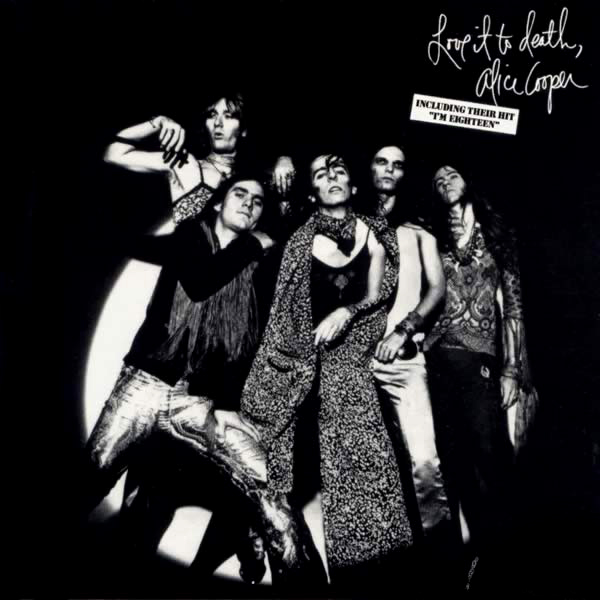
Alice Cooper - LOVE IT TO DEATH (1971)

This was Alice Cooper's breakthrough LP, featuring the hit "I'm Eighteen", which screamed up the charts, received all kinds of airplay, and signified the arrival of this band.

In the cover shoot, whether intentionally (probably) or not, Alice decided to stick his thumb through his pant zipper to make it look like something else. 

I guess the photographer was so engrossed in framing the shot, the lighting etc, that he did not notice Alice's *ahem* indiscretion.

I guess the LP cover designer ALSO  was engrossed in his task, because HE/SHE missed the indiscretion as well.

SOMEWHERE, someone finally notified Warner Bros. of the "offending" cover.  It was already on the stands! Heavens!  what do we do??

Here is the original LP cover below:

I can see the entire morality of teenagers go straight to the shit bucket after viewing this cover.

Well, Warner Bros. decided to pull the remaining copies off the shelves and reissue the LP.  To save money, they decided to airbrush out the offending digit.  But then they had a problem with the exposed portion of Alice's right arm.  OK.  No problem.  Let's airbrush THAT out too.  So below, is the CENSORED airbrushed version:

I mean, REALLY.... I'd be more worried about the band member in the back row, top left.  What the hell is he wearing??  Now THAT, I'd be concerned about........

Friday, October 26, 2012

MEESTER MUSIC HALLOWE'EN SPECIAL


As promised, I will post cover shots of the music from the last episode.

Due to technical difficulties, I will not be able to upgrade this site for a few days. Please check in again.

Thanks!

MEESTER MUSIC

Wednesday, October 24, 2012

LPs Played On Recent MEESTER MUSIC podcast

Cover shots from some of the LPs featured on the last MEESTER MUSIC Radio Show.


PROCOL HARUM - "Broken Barricades"


 GIT OUT THERE

.....FIND 'EM

.....ADD 'EM TO YOUR COLLECTION!!


Tuesday, October 23, 2012

A Hockey Fan's Lament

For all you hockey fans out there who are just as pissed as I am at the prospect of a lost season, check out this great video from a REALLY PISSED OFF fan.   Enjoy!  SEE VIDEO NOW

Thursday, October 18, 2012

Inaugural Podcast

Meester Music has learned how to podcast!

With apologies to radio talent from the past, present and future, we present THE INAUGURAL BROADCAST by Meester Music.

Have the sedatives ready please....


Tuesday, October 16, 2012

Digitizing The "Analogacal"

The technological advances behind recording audio never ceases to amaze me.  Whether it was Edison and his wax cylinders, Berlinger with his original flat record concept, or even the digital era, just think how amazing it is to preserve moments in time forever, to be shared by generations.

I pretty much took all of it for granted.  However, recently I've re-disk-covered (sorry for the pun) my LP collection.  Still unbelievable that my 40+ year-old records still sound pretty good, despite some scratches and such along the way.

Then the CD era came in.  Wow, all that LP on one little disc that fit in your hand.  No needle ever touches this thing.....it will last forever.  how did they do it?  All this talk about pits and stuff, and how the laser could interpret those pits and determine the analog equivalent.  Huh? 

I'm not going to get into the math or physics in any great depth here.  If you're looking for that detail, I welcome you to google your ass off.  There is a TON of info out there.  You just have to go look for it.  It's there.  I'm going to talk in my own language and hope it makes sense.

SAMPLING RATE & BITRATE

The sampling rate and the bitrate are perhaps the two most important things to remember when discussing how an analog signal (or sine wave) gets converted to digital.

SAMPLING RATE is simply the number of times an analog signal is sampled in ONE SECOND.  For red book standard CDs, the talk is always 44,100 hZ.  That means that the analog piece is actually sampled 44,100 times PER SECOND!!

Why 44,100 hz?  Well, there is some extremely complicated math (Nystrom theorem?) that in a nutshell says that you must sample at twice the rate of the frequency you are trying to capture.  Remember that the red book standard says that only frequencies in the 20-20000hz range will be captured on a CD, so 2 x 20000hz = 40,000 hZ (so 44,100 hz sampling rate pretty much covers that.

The next step is what do we do with each sample?  We have 44,100 of them now.  Each sample at that given point in time on the analog wave will be assigned a binary number.  Remember the binary number system?  You can never have a number bigger than 1.  So 0=0, 1=1, 2=10, 3=11 and so on.  This is also called the bit rate.  Now imagine that EACH SAMPLE is assigned a 16-bitrate (2 to the 16th power).  That means that each sample is capable of being assigned a number that looks like

                                     xxxxxxxxxxxxxxxx  where the x could be either 1 or 0. 

That also means that EACH SAMPLE has a combination of 65,546 "levels" that can be assigned to it.  One sample might be 0110100110101101 and the next one might be 0011011010111000.  And this is done 44,100 times PER SECOND.

On top of that, the number of bits are doubled for a stereo recording.  So for the same of argument, your typical red book standard CD has a sampling rate of 44,100hZ and a 16-bitrate (sometimes expressed as 1411 kbps).

So yeah, that's a pretty good sampling rate and that's why CDs approximate an analog sample so well (except for that nasty HARMONICS problem, which I spoke of last time).

MP3 Conversion/Compression

I still think one great technological advance with huge impact was the development of the mp3 format to convert digital music.  Up until that time, digital audio files were in the 9MB range for a typical song.  With the old dial-up internet connections, it would take AGES to transfer one of these files.

Along comes a format whose files are 1/10th (on average) the size of an audio file.  A 9 MB file suddenly became a much smaller file and with advances in internet transfer, these songs could be moved in almost the blink of an eye.

Ahh, but how do preserve the digital signal when you have a file that is roughly a tenth of the size?  Well, you cheat a little.  Again, someone has decreed that since you don't hear much above 14000hz, then we can just LOP OFF the tops of those signals above 14,000hz and kind of approximate later, when we convert those mp3 files back to analog.

And hey...it works pretty good.  The standard bitrate for mp3 files appears to be 128 kbps (wow...did you just notice the difference between that and the CD bitrate, which was 1411 kbps??).  Now, if you're pumping that music through an ipod, through $14 ear buds, you ain't really gonna hear a huge difference.

But put that ipod on a nice Harman/Kardon dock on a nice amp and baby, you WILL hear the difference.

Of course, you could convert to mp3 of 196 kpbs (my personal favourite) or even 320 kpbs (best), but again, keep in mind that the bigger the bitrate, the bigger the file.

You might have to sacrifice some space on your iPod, but boy...your shit will sound great.


Anyway, that's my Sonic Physics lesson for today.

Here's MEESTER MUSIC's rules for digital audio file storage and playback:

I rip all my commercial (not downloaded) CDs to FLAC (free lossless audio codec).
big files (although not as big as wav files).  But no loss, no compression.  It copies EXACTLY what is coded onto the CD.

That becomes my storage "MASTER" if you will.  From there, I can convert those FLAC files to whatever I want:  back to wav to burn a disc, to mp3 (196 kbps) so I can play on my iPod.

That's it.  Enough of the techno stuff.  I start reviewing some of my latest acquisitions plus my favourite all-time LPs.

Ciao.


Monday, October 15, 2012

Bay Bloor Radio Turntable Day

A couple of weeks ago, I made a road trip down to Bay Bloor Radio in Toronto to check out a special Turntable Day they were having.  This is something that BBR does annually, but the first time I was interested in going,

A gentleman named Kurt from Essential Audio (a wholesale distributor primarly of Pro-Ject turntables and related equipment) was giving the presentation.  There was a small listening room set up with a beautiful Pro-Ject debut carbon turntable, an amplifier (NAD I think) as well as a CD player.

The first demonstration was to show the difference between an LP and a CD.  The choice was Steely Dan's LP "Gaucho", track "Hey, Nineteen".  The CD was a commercial (i.e. not ripped or downloaded but store-purchased) copy of same.  Kurt set up both in sync and we heard the LP first, followed by the CD.

WHAT A DIFFERENCE!!  Honestly, if Kurt had played the CD copy first, I would have been impressed by the sound, no noise, etc.  But when he compared to the LP, the difference was (ahem....excuse the pun)  AUDIBLE.  There was a dynamic range to the LP, it felt more ALIVE, more WARM.  It was unbelievable.

To further make his point, Kurt then played a 1973 reissue LP of Dave Brubeck's Greatest Hits and it also sounded great.  Almost no surface noise.  Helps I guess when the LP is cleaned thoroughly then played on a good quality turntable using a felt mat to further reduce static pops and clicks.

So why such a dramatic difference?  Well, my friends, it all has to do with HARMONICS.  for instance, you strike a note on a guitar string and the string vibrates at 12000 hz.  Without delving into the physics, there will be a first (or fundamental) harmonic OVERTONE at 24000 hz, another one at 36000 hz and so on.  The VOLUME of the harmonics are very much less than the original tone. Suffice it to say that a 12000 hz tone does in fact have these harmonics associated with it.

So what?  Well.....back when Sony and Phillips were putting together the RED BOOK standard for Cds, they had many things to consider.  How big should the CD be?  How much information can we fit on there?  How long will a typical CD play?  etc.

They decided that since most folks cannot hear anything outside the 20 - 20000 hz range, we would ignore them and hence the problem.  You are preparing a CD and you've got a 12000 hz tone in there.  What happens to the first (and subsequent) harmonics?  yup...gone.  24000 hz first harmonic is essentially ignored, and guess what happens to that 12000 hz tone that DOES make it onto the CD?   It sounds a little dull, a little flat, a little "less warm".

And in a nutshell, that is why your LP will ALWAYS sound better than a CD.  Next time, I'll talk about how an analog wave gets digitized.  Quite frankly, the technology is amazing.  Don't get me wrong.  I love the portability and convenience of digital music.  But it's always nice to know what your options are, etc.

Saturday, October 13, 2012

The Resurrection Of Vinyl

VINYL is back!!

I don't think it ever went away. It sort of got kicked under the carpet with the introduction of CD's back in the mid-80's.

But I've been noticing lately a resurgence of vinyl. Did you realize that almost every major release is both on CD, Vinyl or a combination of the two? I recently purchased the new SHEEPDOGS release. I was able to purchase the LP (on nice thick 180gm vinyl) and it included the cd as well. BONUS!!

What I hope to do here is relate my vinyl experiences, list some of the great stuff that's out there, maybe drop a few samples etc. I will NOT be sharing LPs anymore. Too much heat out there. Not worth the bother. Sorry, if you're looking for that kind of thing, well....good luck. Try the bit torrents (even though THEY have been shut down as well. Back shortly with my Bay Bloor Radio experience a few weeks back.

- Meester Music

Friday, August 24, 2012

Not Dead....

Wow. It's been over a year. Lots has happened, lots has changed. The blog community sort of went underground and it's very difficult to find sites that will share music. Even the bit torrent community "disappeared". If you didn't know the blog moderator on a first name basis, you were toast. (I guess I would classify as a "leech"). Not sure how to progess from this point on. guess we'll just take it one post at a time.

Thursday, April 07, 2011

Still Alive

Still here. Still alive. Still buyin' great stuff.
Looking to change things up a bit here.
Stay tuned, if yer still out dere, dat is!!
-MEESTER MUSIC